Next year marks thirty years since Gattaca came out. The rockets and the rest of it still look like the future. What’s aged into something closer to a warning is the smaller idea at its centre: a society deciding your worth before you’ve done anything.
I’ve only watched it twice, but I think about it often, and that’s the mark of a great film. Once is enough for it to land and leave something behind. When someone tells me they like science fiction, this is the first film I recommend. It’s the most human science fiction I know, which matters more to me than spectacle.
There are better science fiction films, technically. Sharper plots, bigger twists, cleaner delivery. Gattaca appealed to me at a deeper level than any of them, and I think that’s what art actually is: not how impressive it is, but what it makes you feel.
I’m a mechanical engineer who got placed at an IT company in campus placements. Then the company got caught in a large IT fraud case before I could even start, and the offer evaporated. I ended up taking a job I didn’t want at a mechanical engineering firm back in Bhilai, watching the dream of earning the kind of money my friends in IT were making disappear entirely. I was angry at everything and everyone. Watching Gattaca then, I saw my own struggle in Vincent’s, the same fury he must have felt at a society and a family that had labelled him invalid before he’d done anything. When he reached his dream, by whatever means it took, I felt the joy of it like it was mine. It gave me hope.
Most science fiction looks outward, filling the screen with distant galaxies and technology beyond comprehension. Gattaca looks inward. It uses the future to ask what kind of humanity we actually want to become. Its world is clean, efficient, prosperous. Disease has nearly vanished, lifespans are longer, perfection is no longer left to chance. And it feels completely devoid of warmth. Children aren’t conceived in hope anymore, they’re designed in laboratories, their limitations documented and their worth assigned before they take a first breath. One line captures the whole philosophy of that world: “God’s handiwork, with our improvements.” The dystopia here isn’t built with oppression or violence but with certainty.
The film isn’t really about genetics, though. It’s about a man born “invalid,” predicted to have heart disease, given a life expectancy just past thirty, told from birth that becoming an astronaut is impossible. Vincent’s story resonates because it isn’t about reaching space. It’s about reclaiming the right to define himself, against a society convinced destiny can be read off a strand of DNA. There is no gene for the human spirit. It’s the simplest line in the screenplay and the most important. Even his name carries it. Freeman meant a free man, not a serf bound to the land, someone who owned himself. He’s born with the name in a world that treats him as the opposite.
The cruelty of this world cuts both ways. The engineering damages the “valid” characters just as deeply as it excludes the invalid ones. Vincent’s brother Anton, engineered to be superior, was conditioned from birth to believe biology guarantees his victory, and has no resilience when it fails him. And then there’s Jerome, the man whose identity Vincent borrows, who matters more to the film than almost anyone. Genetically flawless, built to be the best, he came second in a swimming competition and couldn’t survive what that meant. A man engineered for first place, undone by a silver medal. The wheelchair came from a suicide attempt he couldn’t even get right. He lends Vincent his identity, his blood, his urine, his perfect genetic profile, and Vincent does the rest, scrubbing away every trace of himself, scraping off dead skin, removing loose eyelashes, hiding fingerprints, a daily ritual of erasure to pass as someone he isn’t. The two become a strange whole: one man with the dream and the will but the wrong body, the other with the perfect body and nothing left to want. Vincent borrows the genes Jerome was given and wasted. Jerome borrows the hunger Vincent was never supposed to have. People who are never allowed to fail never learn how to fight, and Vincent’s supposed weakness, that nothing was ever promised to him, turns out to be the only real advantage in the film.
My favourite sequence isn’t the liftoff. It’s the swimming. As boys, Vincent and his brother Anton play a game of chicken, daring each other to swim further out to sea, and Anton, engineered to be superior in every measurable way, wins every time. Until one day Vincent doesn’t turn back. He pushes past his supposed limits, beats Anton, and when Anton panics and starts to go under, it’s the invalid who saves the valid, the flawed one dragging perfection back to shore.
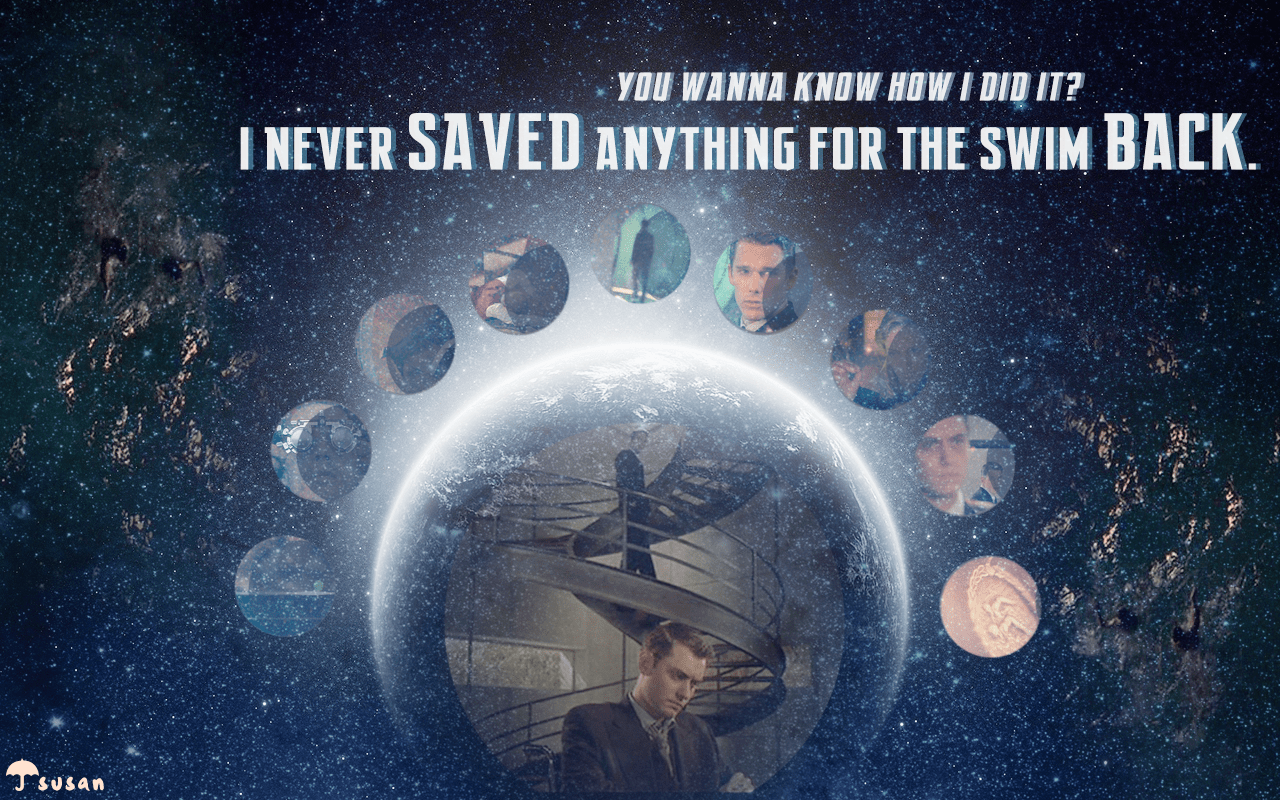
By the time Vincent is on the verge of finally reaching space, Anton, now a detective, confronts him and challenges him to one last swim to settle it. Far out in the dark water Anton panics again, asks how far they are from shore, demands they turn back. When he asks how Vincent is doing this, how either of them is supposed to make it back, Vincent gives him one of the best lines ever written for the screen: “This is how I did it, Anton. I never saved anything for the swim back.”
I’ve had that line saved on my phone for years. Vincent doesn’t win because he’s stronger. He wins because retreat was never part of the plan. He commits everything, no reserve, no safety net, and once again he carries Anton back. It’s exactly what he does with his life, becoming an astronaut knowing his heart could fail and he might not survive the trip.
Nearly thirty years on, the film feels less like science fiction and more like a warning we’re walking into. We’re surrounded now by algorithms that predict our preferences, metrics that measure us, systems trying to quantify our potential before we’ve done anything at all. Gattaca saw it coming, and there’s a small comfort in what it holds onto: there are things about people that still can’t be measured, and that’s the part that keeps us a step ahead of the machines. The stubbornness to keep going when the numbers say don’t bother is the one thing no system has learned to read yet.
Years later, after some living and travelling and reading had given me a bit of perspective, I understood the resemblance I’d felt with Vincent was mostly wrong. My position was largely my own undoing. Vincent’s was something else entirely, a whole society deciding his worth before he could speak. What had changed wasn’t the film but me, and it says something about how good it is that it held up anyway, that it still moved me even after I’d stopped seeing myself in it.
The final narration might be the most beautiful ending in science fiction. “For someone who was never meant for this world, I must confess I’m suddenly having a hard time leaving it. Of course, they say every atom in our bodies was once part of a star. Maybe I’m not leaving. Maybe I’m going home.”